
 By Hadrian - YO2BTW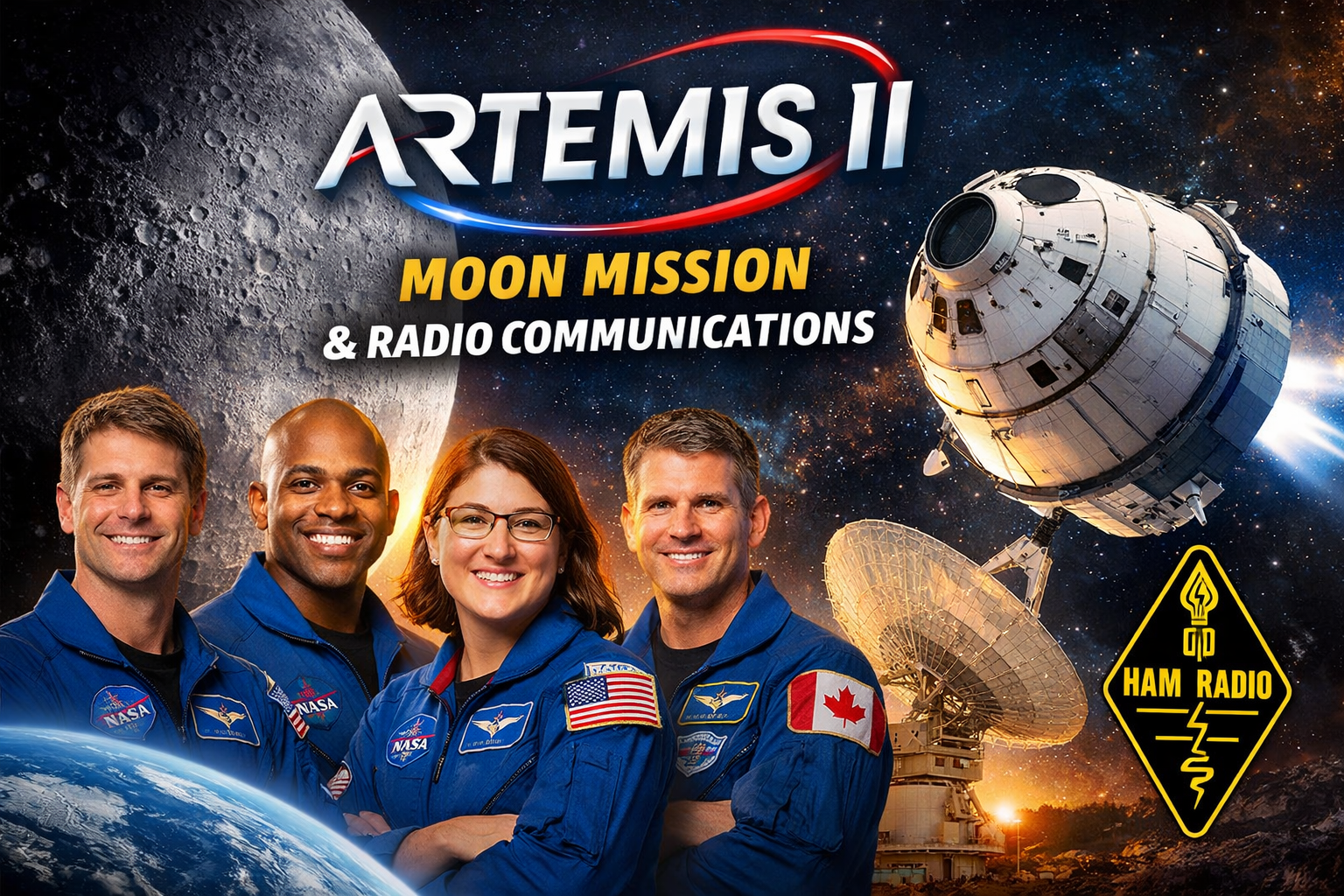
Artemis II – Humans Return to the Moon and the Role of Radio Communications


Introduction
The Artemis II mission marks a historic moment: the first crewed mission to leave low Earth orbit since the Apollo Program.
Part of the Artemis Program, this mission is important not only for space exploration but also for the evolution of deep-space telecommunications, a field of great interest for amateur radio operators.
🚀 Artemis I – The Foundation for What Comes Next


The Artemis I mission (2022) was an uncrewed flight, but an essential one.
What it demonstrated:
- Successful launch of the Space Launch System (SLS) rocket
- Orion capsule operation in lunar orbit
- Reentry into the atmosphere at extreme speeds
- Testing of communications via the Deep Space Network
From a radio perspective:
- Stable communications over 400,000+ km
- Use of X-band and Ka-band
- High-speed telemetry and data transmissions
👉 Essentially, an “industrial-scale” version of what amateur radio operators do with EME (Earth–Moon–Earth) communications.
👨🚀 Artemis II Crew
The Artemis II mission will carry a crew of four astronauts:
👨🚀 Reid Wiseman – Commander
- Former US Navy fighter pilot
- Veteran of Expedition 41 to the ISS
- Experienced in operating complex systems under extreme conditions
👉 Chosen for his command experience and long-duration space missions.

👨🚀 Victor Glover – Pilot
- Former test pilot and naval aviator
- Flew on SpaceX Crew-1 mission
- First African-American on a long-duration ISS mission
👉 His expertise in modern flight systems and digital operations is crucial.

👩🚀 Christina Koch – Mission Specialist
- Holds the record for the longest single spaceflight by a woman (~328 days)
- Electrical engineer, experienced in extreme environments (e.g., Antarctica)
👉 One of the most experienced in operating scientific and technical systems.

👨🚀 Jeremy Hansen – Mission Specialist
- Astronaut with the Canadian Space Agency (CSA)
- First Canadian to fly to the Moon
- Experienced in military systems and complex operations
👉 Represents international collaboration in the Artemis program.

📻 Are the Astronauts Licensed Ham Radio Operators?
An interesting point for the amateur radio community:
👉 None of the Artemis II crew members are publicly known as licensed amateur radio operators (with a callsign).
However:
- Many astronauts have had ties to amateur radio through the ARISS program
- Famous examples include Sunita Williams (KD5PLB)
👉 So, the connection between NASA and ham radio exists and remains very active.
📡 Deep Space Communications


For Artemis II, communications are vital.
Technologies used:
- X-band → command and telemetry
- Ka-band → high-speed data and video
- Deep Space Network
Challenges:
- Signal delay ~1.3 seconds
- Extremely weak signals
- Need for high-gain antennas
📻 Connection to Amateur Radio
1. Similarities with EME (Moonbounce)
- Signal reflection off the Moon
- Need for amplification and filtering
- Working with very weak signals
2. Common technologies
- SDR (Software Defined Radio)
- Digital modes (FT8, JT65)
- LNAs and directional antennas
3. Future possibilities
- Ham experiments on lunar orbit
- Radio relays via lunar stations
- Educational contacts through extended ARISS programs
🌐 The Future of Space Communications


The Artemis Program is paving the way for:
- Lunar communication networks
- Space-based Internet (Delay-Tolerant Networking, DTN)
- Optical communications (laser-based)
👉 These technologies will also influence Earth-based emergency communications (EmComm).
📌 Conclusion
The Artemis II mission is not only a step toward the Moon but also a major leap in radio communication technology.
For amateur radio operators, this means:
- Inspiration
- Validation of weak-signal techniques
- A glimpse into the future of interplanetary communications
73 de Hadrian – YO2BTW
The launch can be followed live: