

 By Hadrian - YO2BTW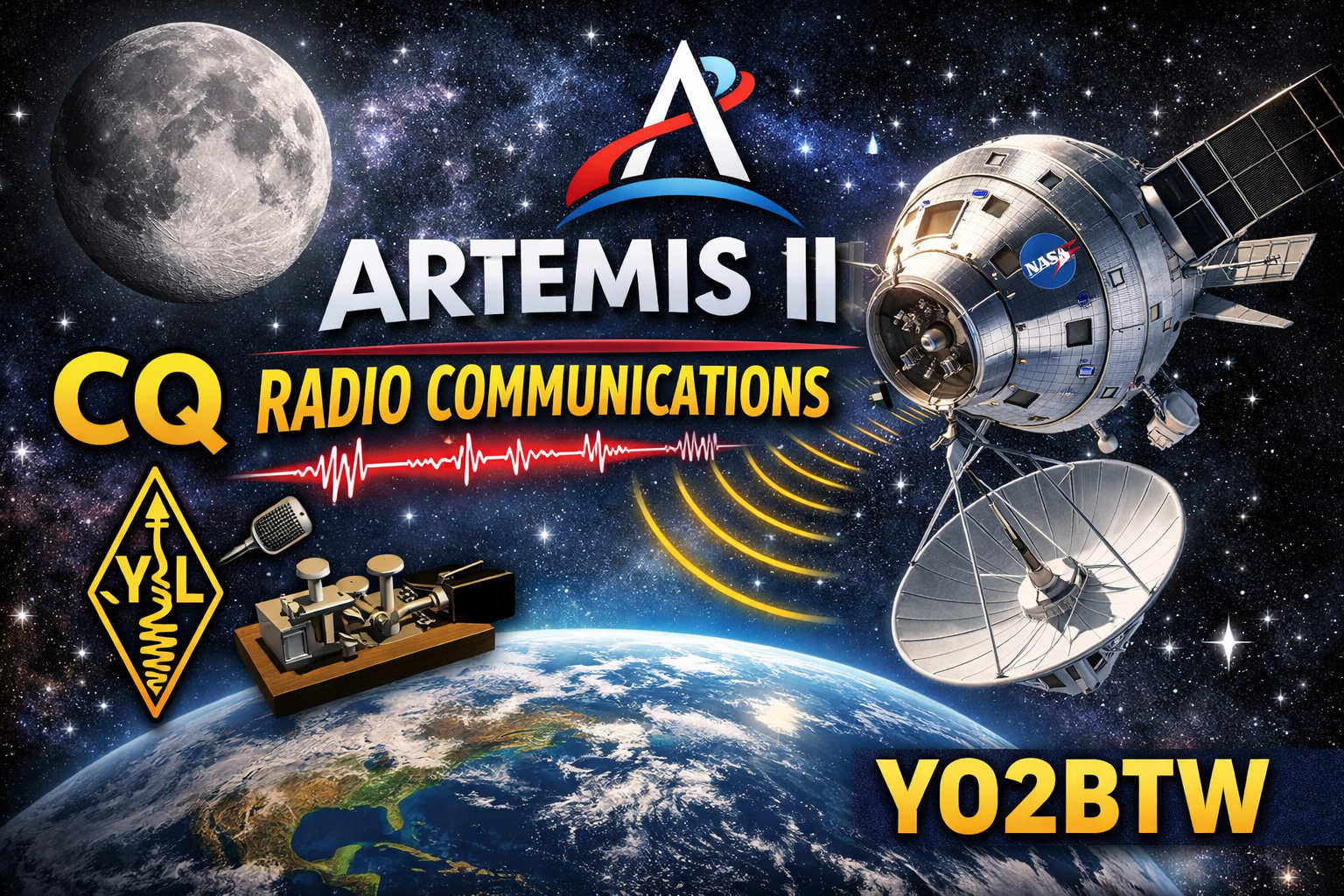
The Artemis II mission, launched on April 1, 2026, marks the first human flight to the Moon in over 50 years and a crucial step in returning humans to cislunar space. Beyond its historic significance, this mission represents a major leap in space radio and video communications, combining traditional RF technologies with state-of-the-art optical systems.
Current Mission Status
At the time of writing, the four-member crew has successfully completed a lunar flyby and is on the return trajectory to Earth, having reached the farthest distance ever traveled by humans in space (over 250,000 miles).
The mission has already demonstrated deep-space communications capabilities, even under challenging conditions such as the radio blackout period when the spacecraft was on the far side of the Moon.
Radio Communications – The Backbone of the Mission
Even though Artemis II introduces new technologies, radio communications remain the foundation of the link with Earth.
1. Deep Space Network (DSN)
The primary radio communication system is NASA’s Deep Space Network, operating in RF bands (mainly S-band and X-band). It provides:
- Telemetry and command (TT&C)
- Two-way voice communication
- Critical redundancy for crew safety
These radio links are extremely robust and function even under weak signals or interference.
2. Notable Radio Achievements
- The first-ever direct “spacecraft-to-spacecraft” communication between Artemis II and the International Space Station – a historic moment in space communications.
- Transmission of tens of gigabytes of scientific and operational data during the flight.
- Maintaining stable communications over record distances, surpassing Apollo-era performance.
3. Radio Limitations
- Total communication blackout (~40 minutes) on the far side of the Moon
- Limited bandwidth compared to new optical systems
These limitations have prompted the development of complementary solutions.
Optical Communications (Laser) – The Future
One of Artemis II’s most important innovations is the Orion Artemis II Optical Communications (O2O) system.
Features:
- Laser (infrared) transmission
- Speeds up to 260 Mbps
- Optical terminal with telescope and high-precision guidance systems
Advantages:
- Data transfer hundreds of times faster than traditional radio
- Near-real-time 4K video transmission
- Higher energy efficiency
Operational Role:
- HD/4K video transmissions from lunar proximity
- Sending scientific images and onboard data
- Supporting complex communications, including live video
Video Transmissions – A New Standard
Artemis II is the first mission to provide:
- 4K video from cislunar space
- Live transmissions with the crew
- Stunning images of the Earth and Moon
These are achieved using modern cameras integrated with optical communication systems.
Conclusion
Artemis II represents a crucial milestone in the evolution of space communications. While radio was the only option during the Apollo era, today we witness a hybrid architecture:
- Radio (RF) – reliability, redundancy, safety
- Optical (Laser) – speed, capacity, future
For amateur radio enthusiasts and communications professionals, this mission clearly demonstrates that even as technology evolves, the principles of radio communication remain fundamental in the most advanced space missions.
Artemis II is not just a mission to the Moon – it is the beginning of a new era in space communications.
73, Hadrian – YO2BTW